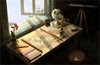
This image symbolizes the choices we make as individuals and the effect it has on who we are. In particular, this has to do with the choices we make which affect our own identity. There are those in society who would shape and mold us in their own way and often this goes against our authentic nature. Often the institutions and structures of society are successful in molding us into something that is against our true individual nature and our identity is lost to us. We become sequestered from our authentic individuality.
Sequestration in this sense signifies a withdrawal into a false reality that is simply given. There are many aspects in society that can distract a person from the things that are essential to that individual’s wholeness and overall well-being. This can be a voluntary withdraw or it can be an involuntary act. In the case of voluntary sequestration, this comes in the various forms of entertainment seen in society such as in television and shopping malls. Being distracted by these things and by excessively engaging in these forms of entertainment an individual can miss out on the opportunities and possibilities that life has to offer. In turn, by being distracted by these forms of sequestration their sense of self is also neglected and the wholeness of the individual is never achieved. Involuntary sequestration comes in the form of restrictions that exist because of structures in society or relationships that can suppress a person’s individuality and creativity. Institutions such as schools that teach people what to think instead of how to think. In certain institutions a person’s individuality is restricted, discouraged, or isn’t even allowed to flourish at all. There may even be relationships where one person restricts or inhibits the growth of another’s character and identity.
The setting for this image is reminiscent of the entrance to a circus or some other entertainment spectacle. We see a ticket booth in the middle, a desolate section to the left, and a bright, inviting area to the right. Looking closer at the area on the left we see posters and objects you might expect to find at a circus. A cage for animals, juggling pins, banner flags, etc. There are trees that have lost all or most of their leaves giving this area an even more run-down and desolate feeling. One might even find the colors in this area to be stark and lifeless. Given what is seen at the entrance one might get an idea that what lies further to the left outside the picture is filled with more lifelessness and cold imagery. Looking at the right side of the image we see that it is strikingly different than the left side. Its look and feel is the polar opposite of the left. The colors are rich, the trees and vegetation are full and lush. It is much more inviting indicating that this area itself represents a form of life while the right side represents a form of death. On the right side the eye is drawn up the stairs and to a red door. This red door can be seen as a symbol of where one might find the life that exists in this area of the image.
The environment of a circus can capture the idea of sequestration. In a circus, people dress up in costumes and wear masks, hiding their identity, and perform stunts and tricks for show. There are two perspectives at a circus. One is the standpoint of the viewer who is just a passive observer of entertainment and those who are the performers who put on a scripted show for the audience. Both of these standpoints can be sequestrative. Those who are passive observers of the spectacle contribute nothing to the show itself. They take in what is given to them directly and have no say or control of what they witness. On the other side, the performers have control and they have the final say of what is shown to the audience. This is liberating in that a performance can be an expression of one’s true nature through creativity, but at a circus the performers must wear costumes, make-up, and masks that, in a more symbolic way, still hide their authentic nature from the viewers. The part that is sequestrative from the performers standpoint is that they must hide behind what it means to be the characters in a circus and conform to their given roles of a clown, lion tamer, ringmaster, etc. Even though there are some degrees of freedom, the true individual nature of the performers is still sequestered by the roles they must hide behind. These roles that are given to the circus performers are similar in that we are given rigid roles by others in society or in some cases we give ourselves roles. By simply accepting roles and conforming to them the true nature our individuality is lost.
Often we gravitate towards forms of sequestration because they constantly surround us and their nature is concrete. There is also an element of instant gratification in forms of voluntary sequestration. In the image the sunlight shines on the desolate area to the left making it stand out more than the area on the right. This indicates the nature of voluntary sequestration which stands out and begs for our attention in our daily lives.
The development of one’s true nature is often tedious, laborious, and very difficult. It is subjective in nature, it is individual, it can even seem elusive, and isn’t easily identified. It’s an ongoing process that has no concrete endpoint. In the image, the area on the right is somewhat hidden, it doesn’t standout as much as the desolate area on the left. This is similar to how the mysterious nature of the authentic self may appear for many in society. This area is in shadow, but is it full of life. There is a fruit tree at the bottom of the stairs and there are more vibrant and living plants in this area. This is symbolic of the rich life that comes with the true wholeness of an individual.
Choosing a lifestyle that is made up of primarily sequestrative elements is an easier path to take because of its concrete nature. However, this not only applies to the external elements, found in the media for example, but also in the roles that inhibit us. The roles that we take on are also concrete in nature. Within roles, there are specific things that are required and expected of us. In modern society there may be more deviation from those specific expectations, but the core element of the roles we are given still dominate our being. As stated earlier, at times we are given roles externally or we give ourselves strict roles to conform to. When we choose to conform to our roles it’s usually because it’s all we know or have known. It is something that is already defined and in a way this can be a comforting element. In contrast, the elusive and unknown nature of the authentic self is territory only the individual can define for himself or herself. Most would choose to remain in their day to day roles because it is something familiar and one might not see value in journeying beyond that. To journey towards one’s true being requires risk, the ability to question, and to honestly look upon one’s own self and see what needs to torn away and what needs to be taken on. This is a task that would be daunting for most because it’s a change in lifestyle that moves people away from what is familiar, it is a journey into something unknown.
The evolution of one’s true individual nature ties in with the goals and aspirations an individual sets up for himself or herself. In many cases, these goals and aspirations do not match those advertised and handed to the individual in a passive manner from outside sources such as in the media, but come from within. They are created and imagined and are often quite different than any ideal that might be advertised to the individual. The authentic nature of an individual lies in the ability to express one’s unique ideas to the fullest. These ideas are not as concrete because it is dependant on the individual to define and create one’s own goals for an ideal life. Expression of these ideas might be something as small as an idea to help promote a better and more efficient workflow on a project or as big as a goal that has a significant impact on one’s life.
The reason for choosing a lifestyle of authenticity over one that is sequestrative lies in how clearly one sees the depth and richness each lifestyle holds. A lifestyle that deals mainly in forms of sequestration can be satisfying and quite enjoyable, but the opportunities and possibilities are much shallower than what can be found in a lifestyle where one truly knows oneself and has the audacity to boldly pursue the goals one would set for oneself. In a sequestrative lifestyle one is essentially limited to what is already present, but an authentic lifestyle is rich with infinite possibilities and opportunities that spring from the creative source of the individual.
The actualization of ideas that come from the authentic nature of the individual is the highest form of expression one can achieve. Expressing an ideal that exclusively comes from outside one’s authentic nature, outside of one’s imagination and creativity, like taking part in an extravagant get-away that is advertised to the individual is less of an expression of one’s own nature, but rather an expression of those who have handed that idea to an individual. A pure expression of one’s authentic nature is a result of deliberate effort and concrete reason behind one’s action.
Those who have ideas and spend days coming up with ideas that can better their own lives and the lives of others are often called idealists or even dreamers. Those with a pessimistic view might dismiss these people and label them as idle dreamers who do nothing but speak of how great things might be. These people might say that it is better to be a practical achiever, one who is grounded in the reality of the way things are and strives to accomplish only what can truly be accomplished. Their viewpoint of idealists is true only to a degree. An idealist is only an idle dreamer when one doesn’t have foresight or put forth the energy to make those ideas a reality.
There is a downside in being too much on one side of this spectrum. A practical achiever who ignores idealists and dismisses them overlooks the opportunities and possibilities of a better life for themselves and for the world simply because of the pessimistic view that their ideas can never be achieved to the fullest. The idealist who spends all day coming up with ideas, but never takes the time or put forth the effort to translate them into reality never achieves anything great for themselves or for the world. The key is balancing the two personalities into one. Creating ideals and finding ways to achieve them, expressing one’s authentic nature, is not only the highest form of expression one can hope to achieve, but is also the liberating path an individual takes in achieving wholeness.
-Jason Godbey
eligo – from the Latin [to pick out, select, choose].
“The solution is to gradually become free of societal rewards and learn how to substitute for the rewards that are under one's own powers. This is not to say that we should abandon every goal endorsed by society; rather, it means that, in addition to or instead of the goals others use to bribe us with, we develop a set of our own.“
-Mihaly Csikszentmihalyi, Flow: The Psychology of Optimal Experience, 1990

This essay analyzes the meaning and symbolism of the image “Invisible”. The scene appears to be in a neighborhood just outside of a gated complex. We see a general store in the foreground with various goods for sale. We also see, opposite from the store, a makeshift bed with a food tray, a flower cart, and a sign with the word ‘invisible’ next to it. These things, along with the unorganized appearance of this area, can indicate that this might be a resting place for a homeless person.
Starting back at the store we see things that would draw a person in. There are signs welcoming visitors and the colors are vivid and warm also inviting the viewer’s eye to this area. The area behind the gates is also warm and inviting, but the gates are closed. People on the outside are restricted from entering this inviting place, it is only reserved for those behind the gates.
Looking closer we notice a very stark contrast between the warm, inviting, clean feel of the area behind the gates and the area in the foreground, especially around the makeshift bed. This is a contrast between the living conditions of those inside and outside of the gates.
As mentioned in previous essays, the concept of sequestration is when a person is closed off from a reality. This can be a voluntary process, in the case of the various forms of entertainment such as television and shopping malls. It can also be an involuntary process and in this case sequestration comes from an external source such as institutions that restrict a person’s individuality and creativity. In both cases, sequestration is when an individual is closed off from the essential in life and is instead confined to mundane distractions or is forced into an existence or way of thinking that goes against their true nature.
This image deals with a form of voluntary sequestration that stems from an attitude a person chooses to subscribe to consciously. Yet, at the same time this consciously chosen attitude can be a result of structures in society that most would be unaware of, thus also making this form of sequestration somewhat involuntary.
Looking around in contemporary society it’s easy to find a stark contrast between the neighborhoods people live in. At times, it even seems to be Marxian, where there are neighborhoods only reserved for the haves and the other neighborhoods are for the have-nots. Gated communities are examples of where the haves reside and the neighborhoods outside of those gates are reserved for the have-nots. In reality, it isn’t this black and white. It is a reality, however, that these structures separate us from others in society and through it there is a greater chance of becoming ignorant of the plight and situation of others. Ignorance can lead to a fearful and irrational way of thinking.
The plight of this ‘invisible’ man in the scene can often be misunderstood by most in society. Usually, most see the homeless as lazy and unwilling to work or find work. Their plight is of their own doing or some kind of negligence on their part. This way of thinking can lead to an exclusive belief that they deserve the situation they are in and in turn they are seen as less-than and are considered outcasts. Another way of putting it is that they made their bed and now must sleep in it. However, this is just an ignorant generalization of all those who live on the streets.
Certainly, there are those whose plight is of their own doing and there may be those don’t want to work, but there are others whose plight is a result of external circumstances beyond their control. These people might have been some of the hardest working people and now want to find work, but they were driven into their plight and are still currently in their situation through external circumstances.
This also goes beyond the homeless and their situation. This misunderstanding of an individual and their situation that stems from ignorance and irrational generalizations extends to everyone in every group in society. In psychology there is a term known as the fundamental attribution error. This is when we attribute an individual’s action based on their character, part of who they are, when in reality their behavior might be influenced by social or environmental circumstances beyond their control. Studies have show that the fundamental attribution error is made more often in cultures that focus more on the individual, individualistic societies, rather than those that focus on the group, collectivist societies.
These generalizations and irrational thoughts lead to a form of sequestration. When taking an exclusive attitude that others are less-than we close ourselves off to them because we deem them as unworthy of our attention or even acknowledgment. We want nothing to do with those who are not like us and they become invisible to us.
Another negative effect of these generalizations and unfounded thoughts is that it can lead a person to subscribe to an irrational distrusting attitude. This irrational distrusting attitude is another form of sequestration. Usually, a person that takes on this attitude closes oneself off from others out of fear. This can be attached to a fear of exploitation or simply a fear of being rejected, or harmed in some way, by those who trust is given to. In the case of exploitation, one might be hesitant to give their trust to someone they don’t know out of an unfounded fear that by giving their trust, they will be taken advantage of. This attitude can consume a person to the degree that they are hesitant to giving their trust to anyone at all based on irrational and unfounded thoughts. At a young age we are often taught to be distrusting of strangers, but this way of thinking can be carried into the life of a mature human being who is capable of distinguishing between reasonable, legitimate requests and opportunities and those that are questionable and might lead to a form of exploitation itself. Studies have shown that those who have a distrusting attitude of others are just as likely to be conned as those who have a trusting attitude. Those with a trusting attitude are still just as likely to pick up on when someone is trying the exploit them. This trust, of course, is not a naïve one that doesn’t question or weigh the legitimacy and consequences of a request or opportunity. This trust is also about giving someone the benefit of the doubt and trusting them until the other person has proven that they cannot be trusted. This can be seen as the highest form of trust, it is optimistic.
Some might question the need or benefit for taking this standpoint. A person that chooses not to take this standpoint is certainly within their right to do so, but as a consequence they miss out on opportunities and a more enriched life that can follow. The pessimistic attitude of constant distrust sequesters oneself from experiencing fulfilling and lasting relationships with other people.
Hesitation in giving trust to another person can also come from a fear of rejection or harm in some way. It is true that when opening up oneself to another person there is risk involved. However, in order to live life fully and experience everything it has to offer, taking risk is a necessity. Otherwise a person’s life would be confined to a mundane and lifeless routine. If you do what you’ve always done, then you’ll get what you’ve always gotten.
When there is a negative consequence after trust is given one can become even more hesitant in giving their trust again. However, it would be a mistake to use one instance of negative consequence to generalize all other possible consequences of trusting others. Again, this is a pessimistic view that sequesters oneself from the opportunities of a more enriched life. The pessimist would conclude that the risk of trusting is too great because of the suffering or loss that they might have to endure. Often in contemporary society we are taught that suffering is a bad thing and should be avoided at all costs. To avoid suffering at all costs would be to avoid living at all costs. Suffering is just as much a part of life as pleasure. Certainly, pain and suffering are not desirable, but it is through suffering that we grow as individuals. Suffering produces endurance, endurance produces character, and character produces a strong will and hope. And it is in this strength and hope that we are able to live more fully and completely.
The optimist sees that the abundant rewards of opening oneself to others brings about an experience of an enriched and fulfilling life that far outweighs any risk, pain, and suffering one might have to endure. The optimist looks for the good in every person and the best in every situation and it is through this attitude that an individual is free.
Going back to the image one notices that the standpoint of the viewer is not within the walls or behind the gates of the exclusive community, but is right in the middle of where things are taking place. There is a very open feel to the store. Goods are laid out all along the sidewalk and there are welcome signs in the shop window. This points to the inviting and open attitude of a person who is not fearful or overly cautious about opening their lives to others and even going so far as to share what they have.
The pessimist is sequestered by choosing to close themselves off from the opportunities that come from opening up to others. Whether it be because of the risk and work involved or because of the suffering and pain that one had to endure in the past, they become a prisoner to fear. In this fear one cannot truly live a full and enriched life and be able to experience all life has to offer. It is through this fear that one is likely to gather together a list of regrets and dream about how things might have been. It is the optimist that is not bound by fear, but embraces life with a fiery passion and lives without regret because it is from this standpoint that life is lived completely and to the fullest.
-Jason Godbey


Meaning and Symbolism of Exodus

This image is part of a series dealing with the concept of sequestration that can be found in contemporary society. Exodus symbolizes an escape from these forms of sequestration. Sequestration in this sense signifies a withdrawal into a false reality that is simply given. There are many aspects in contemporary society that can distract a person from the things that are essential to that individual’s character and wholeness. This can be a voluntary withdraw or it can be involuntary as a result of situations and circumstance beyond the individual’s control. In the case of voluntary sequestration, this comes in the various forms of entertainment advertised to the public such as in television and shopping malls. Through engaging excessively in forms of voluntary sequestration an individual can easily lose sight as to what is important and essential to the individual and thus fail to engage and experience life to the fullest. As a result their sense of self is also neglected. Involuntary sequestration can be the result of oppression and can manifest a fear of exploitation. It can also come about as a result of structures in society and certain institutions that focus on strict rules that can teach away a person’s authentic self and creativity. These institutions usually focus on teaching people what to think instead of teaching individuals how to think for themselves. It can even come in the form of certain situations people are driven into, through their own doing or external circumstances.